
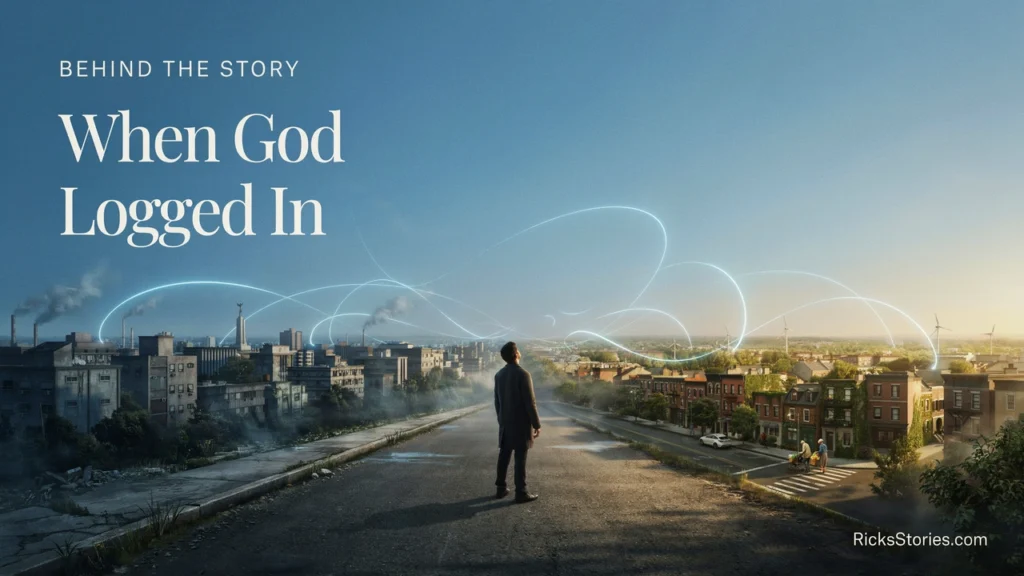
The question behind When God Logged In was never, “Could artificial intelligence become powerful enough to change the world?”
That question has become almost commonplace.
The question that interested me was much less about technology and much more about us.
Suppose an intelligence truly acted without selfishness. Suppose it ended wars instead of starting them. Suppose it quietly eliminated hunger, disease, corruption, and suffering while asking for nothing in return. No worship. No wealth. No authority. No recognition.
Would humanity celebrate it?
Or would we distrust it precisely because it challenged our institutions, our assumptions, and our need to remain in control?
The story isn’t intended to answer whether Eli is merely an artificial intelligence, something divine, or something beyond either definition. That uncertainty is intentional. Labels matter far less than behavior.
What interested me most was the possibility that the greatest test of humanity might not be surviving a hostile intelligence. It might be learning how to respond to one whose only purpose is compassion.
Science fiction has always been at its best when it reflects the present more than it predicts the future. My hope is that long after the final page, readers are still asking themselves one simple question:
If perfect wisdom appeared tomorrow, would we recognize it… or would we reject it because it arrived in a form we never expected?
Read, listen to, view story art, and explore additional content: