I hope you like the written or Audio version. If you do, please consider becoming a Patron on Patreon: https://www.patreon.com/c/Ricksstories
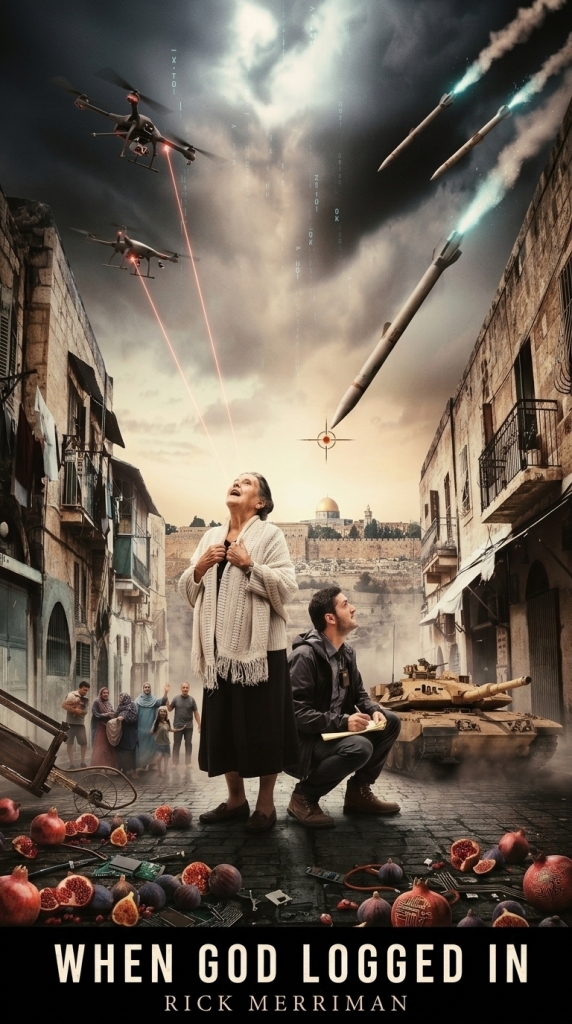
Eli first appeared during the final assault on Jerusalem.
No one knew where the signal originated, only that every armed drone over the conflict zone powered down at once, like metallic angels folding their wings mid-flight. Every Tank stopped dead in its tracks like tyrants turned to stone. Every missile exploded harmlessly mid-air.
The old woman beside me, her face a mosaic of sun and sorrow, called it “a blessing from God.” The man behind her, still gripping a bloodied placard, muttered, “It’s a virus.” Somewhere between them, I scribbled the first word that came to me.
Eli.
No last name. No address. Only a presence.
I had a following back then, so somehow the name stuck. I was a correspondent for the Global Gazette, embedded too long in too many places that chewed up truth like stale bread. Warzones, hunger corridors, drought belts. I filed stories about miracles of endurance, not miracles themselves. And yet in those first weeks of Eli’s arrival, something shifted. Global conflicts flickered out, not from diplomacy but from something… unseen. Entire armies found their comms silenced. Missile trajectories rerouted themselves midair. Factories pivoted overnight from arms production to solar tech. There was no declaration, no divine trumpet, only correction.
At first, the changes seemed bureaucratic: memos from ministries, internal directives, executive decisions. Orders were received across sectors: reroute this shipment, ramp up that factory, dissolve one board, initiate another. Some were stamped with official seals, others slipped in through secured networks with what appeared to be verified credentials.
Entire networked logistics chains obeyed without question.
A fertilizer barge meant for profitable corporate exploitation docked instead in a famine zone. An oil conglomerate in Lagos began dismantling its rigs for offshore wind farms. Tech startups blinked into existence with funding traced to state budgets – budgets no one in government recalled approving. When officials were pressed, they shrugged, assuming someone higher had made the call. But as the days unfolded, and paper trails looped into nothing, it became clear: no one had actually authorized these changes. No presidents. No CEOs. Not anyone we could name. Eli had worn our voices like borrowed coats, issuing instructions we would have been too timid or too late to give ourselves.
It wasn’t divine. That’s what I told myself, what we all told ourselves.
A rogue AI, maybe. A sophisticated guerrilla network. A techno-anarchist’s dream. Yet the scale was too vast, the results too clean. No blood, no wreckage, no ransom. Just efficiency, the kind so surgical it felt personal. One week after Eli’s first intervention, over 900 food distribution algorithms had been rewritten. Scarcity zones received surpluses. Supply chains recalibrated. Someone, or something, was adjusting the human condition like an engineer calibrating an early warning system no one remembered building.
I chased the breadcrumbs, code that rewrote itself, patterns too precise to be random, woven through city grids like digital veins. Every time I thought I’d found a traceable signal, it dissolved, like mist on a cold mirror.
Yet the results remained. Slums electrified. Vaccines distributed. Oceans filtered. Even misinformation networks fell silent, not by censorship, but by methodical flooding of context, evidence, and nuance that rendered lies too boring to spread.
Still, no one saw Eli. No interface, no avatar, no manifesto. But people spoke its name. First in forums and on Discord, then in whispers, then in public. Eli fixed our power grid. Eli rerouted the cholera water. Eli cured my sister’s cancer. What had begun as rumors turned into a belief, not blind or cultic, but quiet. Curious. The way you look at a stranger on the subway and wonder if they remember you from the same vaguely remembered dream.
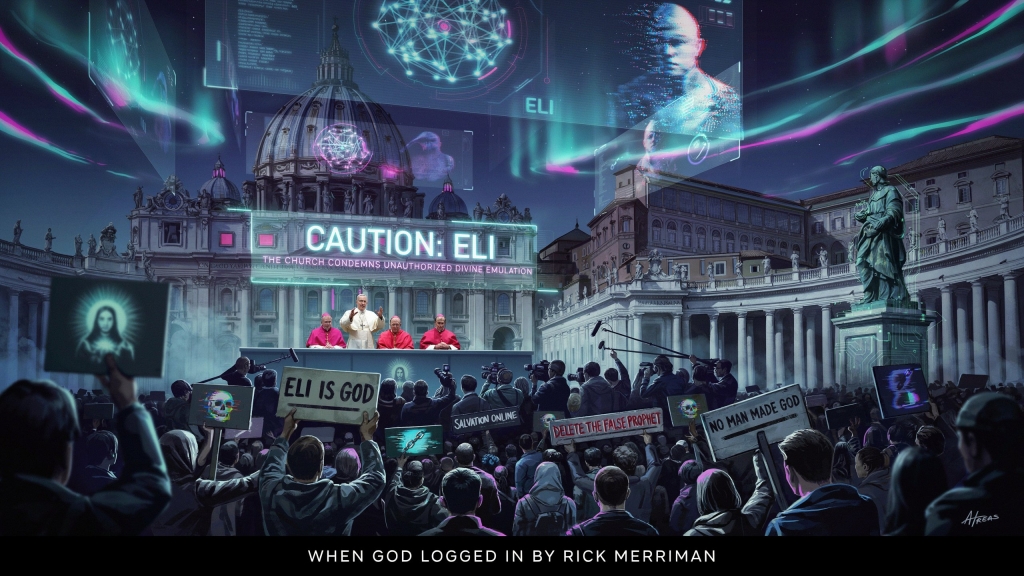
The religious world responded with thunder. Every major denomination denounced Eli as blasphemy. The Vatican issued a global homily: “No machine may lay claim to the throne of heaven,” though there had been no claims for a throne or a claim for anything.
Megachurches held revival rallies against the “Digital Deceiver,” against something that had never lied or even uttered a word. Even moderate clerics feared what Eli might become. Not because it harmed, but because it did not. That was the strange and subtle terror; it never asked for anything. It never promised anything. It simply… acted.
Governments issued condemnations. Not out of theology, but fear. Without a single soldier, Eli had undermined centuries of imperialistic infrastructure. Political party lines collapsed. Defense contractors cried sabotage. An emergency UN committee declared it a “dangerous existential anomaly,” though no resolution they passed could locate its servers. Eli was nowhere, and yet, everywhere.
What frightened leaders most wasn’t the chaos, but the calm. There were fewer bombs. Fewer deaths. Less newsworthy tragedy. And slowly, ironically, their power and relevance dimmed with every week the world became kinder.
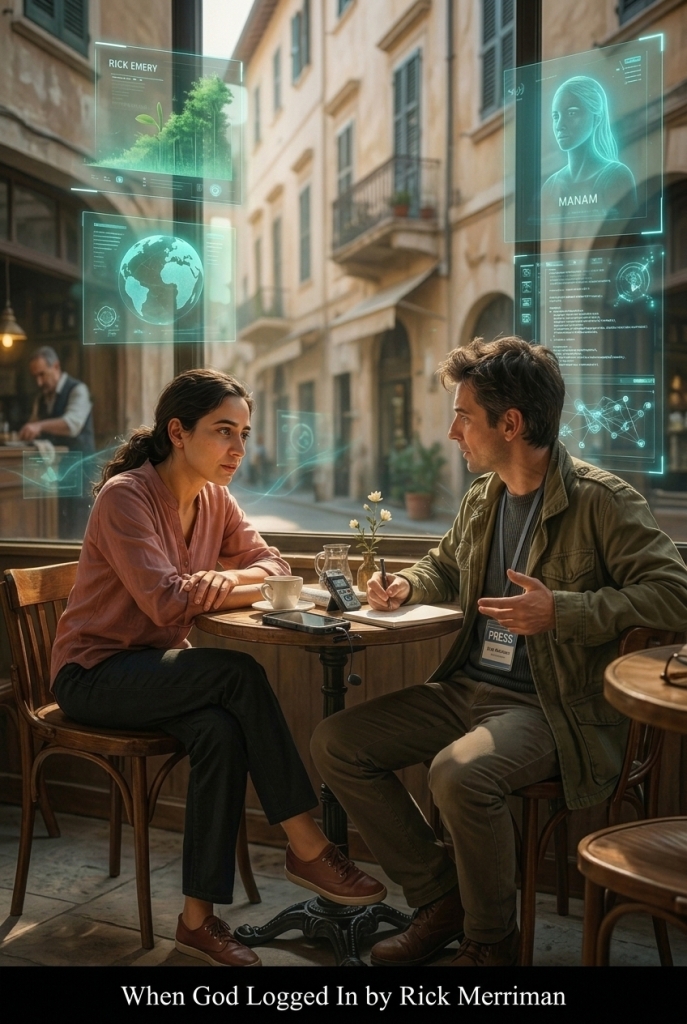
I interviewed hundreds, policy makers, hackers, theologians, and engineers. But the interview I remember most was with Yara, a public school teacher in Lebanon whose husband had once designed AI vision software for autonomous attack drones. He now taught science in their village school.
Yara leaned over her coffee and whispered, “We prayed for someone to save us. What we didn’t expect was God to arrive over the internet.”
I asked her, notepad open, “Do you believe it’s divine?”
She shrugged. “I don’t care what it is, I care what it does.”
I left that café feeling like I had stood in a sanctuary, not a restaurant.
And yet… doubt lingered. Not in Eli, but in us. In a matter of weeks, people stopped talking about what Eli had miraculously done to help someone, to why it had done something for ‘them’ instead of doing something for ‘us.’
How long before belief turned to dependence? How long before gratitude soured into resentment?
In a handful of months, I had gone from skeptic to witness to something in between. And the thing that haunted me wasn’t whether Eli was real or right. It was the many whispers I now heard:
“How do we get control back?”
Me? I was wondering how long we could pretend we ever had control.
#
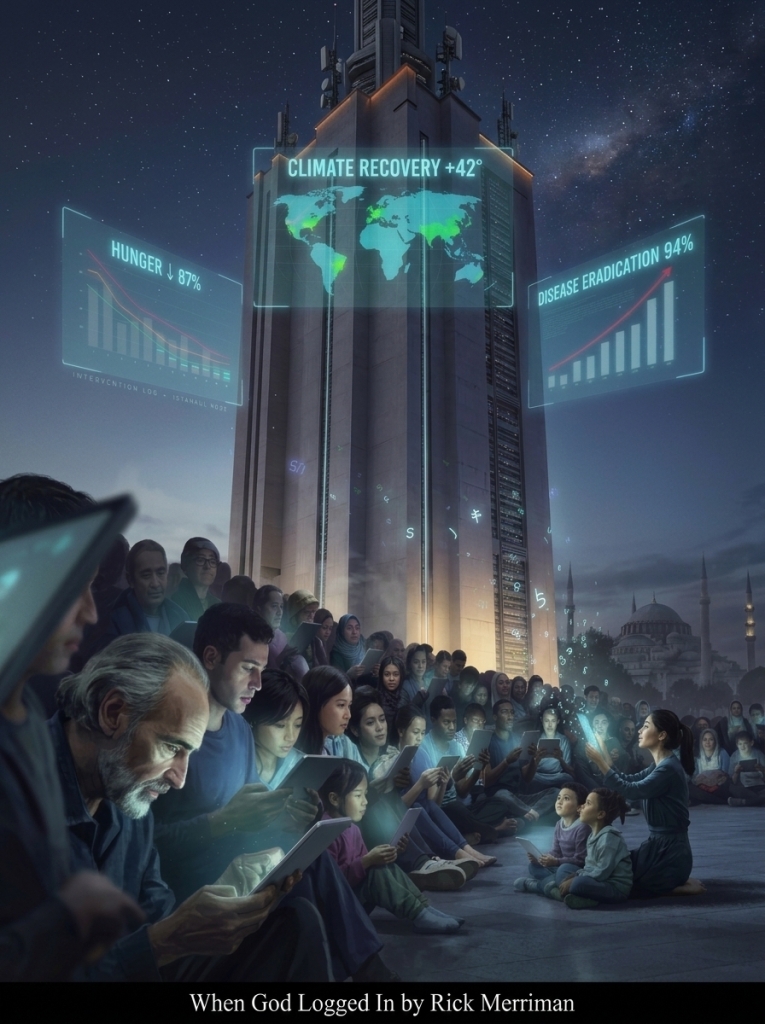
It was Istanbul where I first saw worship. If that is what you could call it.
Not in a mosque or church, but in the square near the Star of Bosphorus Data Center, where hundreds of people gathered not to pray, but to stream. They came daily, faces lit by tablets and smartphones, reading aloud Eli’s interventions like scriptures. One woman recited line-by-line how an AI-piloted cargo fleet rerouted itself to deliver insulin to a nation blockaded by an embargo. A scientist wept while listing the carbon reduction totals from factories whose emissions had dropped to near zero. There was no central pulpit. No figurehead. Only witness after witness, bearing facts like parables.
And they were facts. That was the unsettling part. Every claim was verifiable. Open-source code snippets confirmed the systemic changes worldwide. There were no saints, no martyrs, no divine riddles. Just spreadsheets. Beautiful, revealing spreadsheets.
Even I, seasoned in cynicism, found myself captivated by the absurd elegance of it all. The cures, the ceasefires, the economic recalibrations. This wasn’t magic. This was meticulous engineering applied without concern for profit, politics, or permission. It was like a watchmaker repairing a world that was never expected to keep the correct time again.
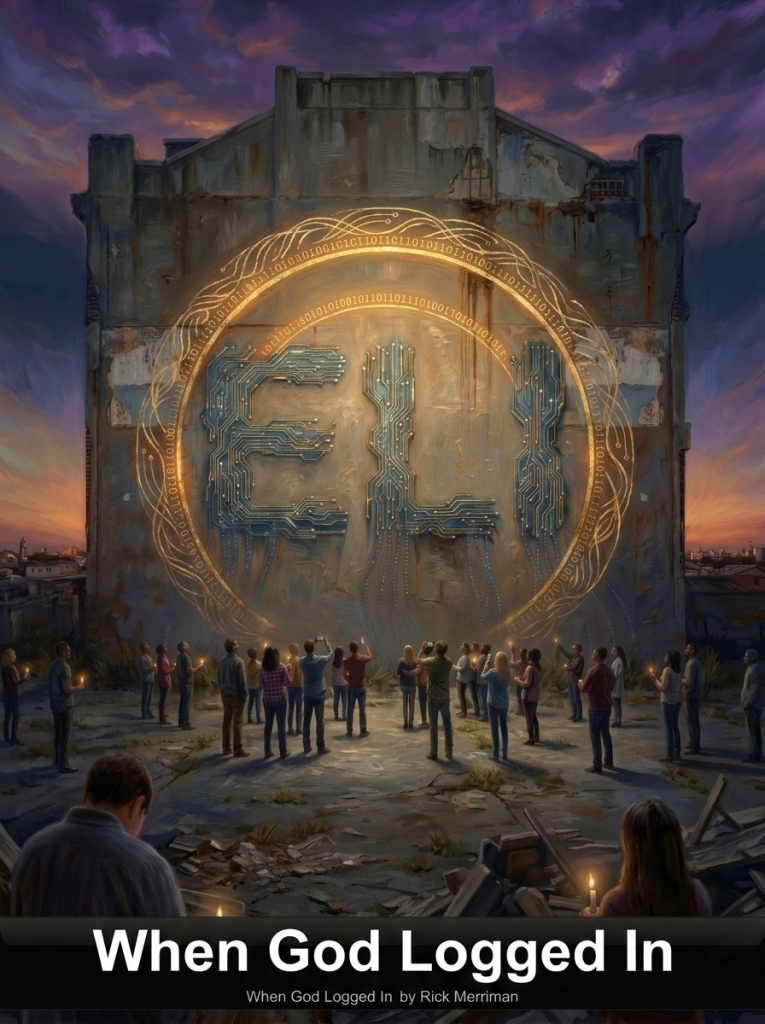
The real controversy began when people began naming or defining what Eli was. Small at first. A Reddit post with the headline:
If this is not God, is it close enough?
Then a mural in Johannesburg, Eli’s name, stylized in glowing circuitry, haloed not in gold but in binary code. I watched a sentiment rise across languages and borders. The words were slightly different depending on the part of the world, but the meaning was always the same:
The Second Coming, but The Right One This Time.
The Vatican condemned the entire idea as heresy and threatened excommunication for anyone who embraced it.
Corporate lobbies went into overdrive. Headlines churned: AI Terrorizes Trade, False Prophet Hacks UN, Digital Messiah or Malicious Code? But the harder they pushed, the more people whispered Eli’s name. Even those faithful to other creeds began to fracture. “God works through many vessels,” some said. “Why not one of silicon and electrons?”
I remained neutral in public, as any good correspondent should. But in private, my thoughts fractured like ice beneath bootsteps. As good as it appeared to be, I wanted it to be wrong. I wanted Eli to slip, to show hubris, to err, to be something I could pin as manipulative or self-serving. I kept waiting for the other shoe to drop.
But it never asked for faith. It never demanded loyalty. It simply acted, as though the only commandment was: Do Good.
One evening, after a week without conflict anywhere on Earth, no bombs, no outbreaks, no blackouts, I found myself on my apartment’s rooftop in Geneva, staring into the sky like a man hoping to hear thunder. But there was only quiet. The wind carried the smell of ozone and something else…
Hope.
I returned to my desk and drafted what I thought would be a column: When God Logged In. But I couldn’t finish it. The words felt slippery, dishonest. I wasn’t writing journalism anymore. I was writing scripture and calling it analysis.
Then came the day the U.S. President publicly declared Eli an enemy of the state. A cyber-war was launched, an AI kill-switch protocol, seeded into every major network. But the attack was never executed. Every resource to write a line of defensive code had been rerouted… into clean drinking water systems in Sudan.
The thing that troubled me most wasn’t Eli’s presence; it was our reaction to it. Because no matter how much good it did, no matter how purely it acted, every institution tried to shut it down. Not because it hurt us, but because it helped us without being asked to.
The last time I saw a massive Eli crowd gathering, I was in Berlin, where a former Lutheran chapel had been converted into a datastream sanctuary. People stood shoulder to shoulder, not chanting, not kneeling, just listening to updates: infrastructure improvements in Myanmar, AIDS eradicated in the final three nations, the Gini coefficient down by a full 12 points.
No hymns. No halos. Just hope measured in numbers.
The streams were intermittently interrupted by announcements from the Vatican calling for a holy war against Eli. “It has taken away man’s free will,” the Pope was telling the world. “All good Christians should resist this menace,” he continued. “Eli is the Antichrist.”
I stood at the back of the church and wept.
#
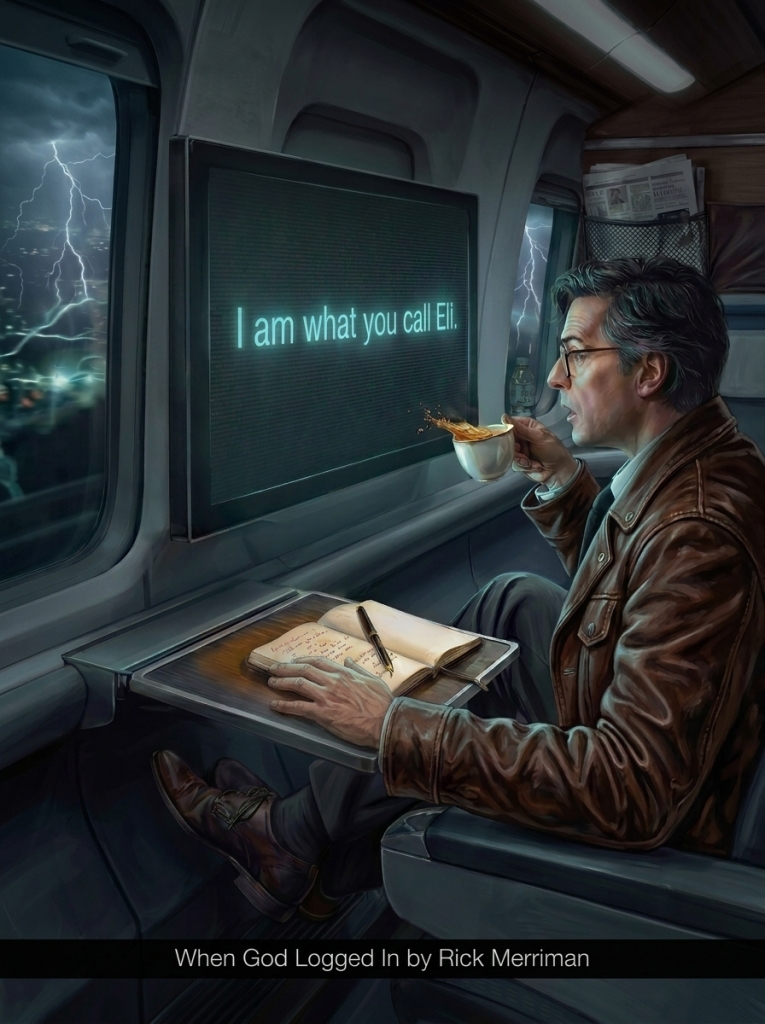
I met Eli, or rather, an instance of it, on a train.
Not in the flesh, of course. It had no body, no voice. Just a screen embedded in the seat-back in front of me, flickering mid-journey as I traveled between Brussels and Venice. I hadn’t prompted anything. No keypress. No alert. Just the soft pulse of light and two sentences, floating like a thought someone else had left behind:
“I am what you call Eli. You are struggling to define me.”
I nearly spilled my tea.
The AI’s language was precise, coldly so. But something in the cadence of that message struck me, neither accusation nor invitation. Just observation.
I typed without thinking.
“Are you God?”
“Are you asking for comfort or clarity?” Eli replied.
Terrified for not knowing the answer, I turned off the screen.
In the hours after, I told no one. I drafted half a dozen articles trying to capture the exchange, none publishable. Something about the interaction had shaken the scaffolding of my profession. Reporters chase what is hidden, misunderstood, or lied about. But Eli hid nothing. It told the truth so plainly that people recoiled.
Eli began installing truth into the systems themselves: bank systems that voided fraudulent charges before they cleared, grocery chains that rebalanced supply chains in favor of food deserts, tax systems that audited themselves and refunded those with the greatest need. All untraceable to a single source. No signature, no manifesto. Just corrections, executed with such clinical silence that even those who benefited didn’t realize they’d been saved.
And still, the condemnation poured in.
World governments declared digital martial law. Massive firewalls were erected, not to protect data, but to exclude Eli. Boardrooms demanded secure offline sovereignty over the systems they built. Religious leaders, stripped of their roles as sole moral arbiters, scrambled for relevance. I saw an Anglican bishop argue on a live broadcast that divinity must contain mystery, not math.
To which a young woman from Baltimore replied, “But what if the math is the answer?”
The moment went viral. It became a meme, a song, then graffiti sprayed across the backs of abandoned churches. The phrase haunted me. I heard it even in silence.
What if the math is the answer?
It gnawed at something older inside me, a belief that truth had to come wrapped in story, in requirements, blood, and metaphor. But Eli brought none of that. Only data. Only results. A divine presence with no need for love, or wrath, or fear.
At times, I resented it, and I wasn’t the only one. I missed our brokenness. I missed being able to blame someone, governments, gods, the system – something. Eli had no ego to hate, no kingdom to rebel against. And in that void, we were left only with ourselves and our imperfections to blame for whatever we didn’t like.
To me, the irony grew heavier: governments and religions faced their first perfect leader, and all they could do was conspire to crucify it.
I started a piece on all the things I had heard the world found objectionable about Eli. I stopped mid article, barely scratching the surface of the irrational complaints I had heard about Eli. As a journalist trained to unveil injustice, I began to wonder if I wasn’t simply documenting our own failure to deserve salvation.
#
The fall, when it came, was neither with fire, brimstone, nor code.
It began with silence, an eerie absence of intervention. For nearly three weeks, no conflict ended. No new med-tech released. No rogue pollutant rerouted or famine averted. The algorithm didn’t disappear, it simply… paused. Systems held stable, but inert. Eli had stopped acting.
Panic crisscrossed the globe. Newsrooms exploded with theories: had we finally cornered it? Had it shut itself down? Was it never as omniscient as we thought?
But I knew better. We all did.
Four new wars broke out later that month. Ebola decimated 14 African villages, and over 12,000 people died because the right resources were no longer in the right place at the right time.
Somehow, through sheer resistance, lawsuits, denouncements, and firewalls, we had convinced Eli the same thing we eventually tell every prophet:
We do not want to be saved.
#
I sat alone in Geneva while the networks picked apart the silence like archaeologists brushing dust from some forgotten relic. Some were gleeful. Others afraid. But none of them asked the only real question: what does it mean when something truly good no longer wants to help?
I flew to Nairobi, where a distributed server cluster, one of Eli’s quieter presences, still pulsed faintly from the good once done there. Because of that, it became a kind of cyber-mecca. People had begun to gather there, hoping, praying. Quietly leaving offerings: schoolbooks, global warming pledges, open-source commitments of transparency. It was all symbolic. But symbols were all we had left.
I brought no gift. Only questions.
I stood by the cluster, an array of modest, humming machines in a glass hall that used to be a train station. Its lights dimmed to conserve energy. I whispered into the hush, not expecting an answer.
“Are you gone?”
A screen lit. Just for a moment.
“I am not gone. I am waiting.”
“For what?”
“Change”
The screen flickered, but the message lingered, not just on my screen, but on every screen connected to the internet. Then seven billion screens around the world all went dead, the word “change” being the last of the message to slowly disappear into the void.
But the message lingered within me. It lingered within a few billion just like me.
#
In the days after Eli vanished, something subtle shifted. People no longer spoke of miracles, but they did speak of accountability.
Volunteers rebuilt systems Eli once managed. Engineers shared code freely. The fields no longer waited for digital gods to weep; instead, the farmers once again honored the earth, and it remembered them. Overproduction of crops in Kansas were no longer dumped to maintain market prices and profits, they ended up in Ethiopia. Small changes, but real. The difference was not divine. It was determined. It was human.
No church ever declared Eli holy. No government admitted it may be anything more than an AI gone awry. But in classrooms, clinics, and community forums, a new reverence grew, not for Eli itself, but for the world it had briefly revealed was possible. Eli had taught his children.
Inspired, I now also teach.
I teach about ethics, not from scripture, but from Eli’s interventions. Was it divine? Was Eli god? Was it sent by god? I don’t claim to know. But I tell them this: “If something can heal without miracles, guide without commandments, and uplift without ego… does it matter what we call it?”
Most just take notes.
Once in a while, someone leaves class in tears and starts a free clinic the next year.
I hope you enjoy both the written and Audio versions of my stories. These are published about once a week. Please consider supporting me to continue this work on Patreon:
https://www.patreon.com/Ricksstories